Startup Funding Roundup – India (Mar 1–8, 2026) Funding Slows to $98M — A Clear Signal of Selective Capital
At first glance, early March looked quiet low for startup capital.
Only about $97–98 million was raised across roughly 11 deals, It is lower than the previous week’s funding levels.
But the slowdown doesn’t mean a funding freeze. Instead, it reveals a deeper pattern: capital is flowing into fewer, more selective bets rather than spreading widely across the ecosystem.
Executive Summary
Between Mar 1–8 2026:
-
Total funding: ~$98M
-
Total deals: ~11
-
Ecommerce and consumer platforms saw the largest allocation
-
AI healthtech and EV mobility also attracted strategic investment
The pattern indicates that investors remain active but cautious, prioritising startups with clear market traction rather than speculative growth narratives.
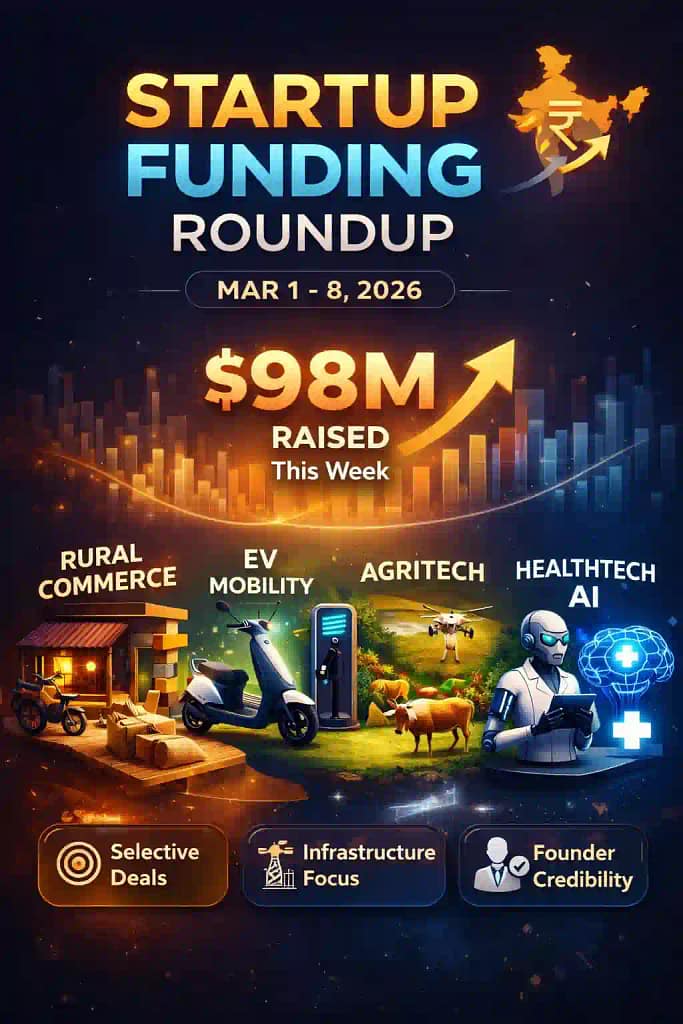
📊 Funding Summary Chart
| Startup | Round | Capital Type | Investors | Amount |
|---|---|---|---|---|
| Rozana | Growth | Rural Commerce (B2B/B2C) | Bertelsmann India, Fireside Ventures | $30M(approx ₹290 Crore) |
| Bounce | Internal Round | EV Mobility | Accel, B Capital, Qualcomm Ventures | $5M |
| Cent | Seed | Healthtech / AI | OneFlow Holdings, South Park Commons | $5 Million(reconfirm this one ) |
| eVerseAI | Grant / Institutional | Agri-Tech / Climate Tech | IIT-BHU I-DAPT Hub | ₹40L (~$50K) |
(Only confirmed publicly disclosed deals during the week.)
1️⃣ Rozana – Rural Commerce Platform
Problem Statement
While urban India enjoys 10-minute deliveries, rural India is still stuck with fragmented, unreliable supply chains. Deep-village consumers are often forced to choose between overpriced local goods or traveling kilometers to the nearest town. The “big players” haven’t been able to penetrate these areas because the logistics cost (CAC) usually eats up the margins.
Company + Founder + Vision
Rozana, founded by Ankur Dahiya, operates a rural commerce network combining wholesale supply chains with digital ordering infrastructure. The company focuses on bringing organized retail logistics to smaller towns and villages.
Rozana’s long-term vision is to create a digitally connected rural commerce backbone for India.
Previous Funding Timeline
-
Early seed funding from Fireside Ventures
-
Subsequent growth rounds from Bertelsmann India
-
2026 – $30M funding round
Industry Condition
Rural commerce platforms face:
-
Logistics complexity
-
Lower purchasing power markets
-
Infrastructure constraints
However, the category offers large long-term demand due to India’s rural population size.
Why This Funding Is Critical
The capital allows Rozana to:
-
Expand village network coverage
-
Strengthen supply chain logistics
-
Improve digital ordering infrastructure
The startup already serves 21,000 villages across northern India, demonstrating operational scale.
Rozana – Working Model
Though their website is not giving much information about their Working Model even their app is also letting us buy only one product at a time but their linkedin page overview says : The “Sarthi” Network Rozana operates a Peer-led Omnichannel model. Unlike urban apps that hire delivery riders, Rozana recruits local village influencers (mostly women ,village youth , small shopkeeper) called “Peer Partners” or “Saarthis.”
-
Aggregation: Neighbors place orders via the Saarthi; Rozana delivers a bulk shipment to the Saarthi’s home.
-
Trust Factor: Villagers buy from a neighbor they know, which solves the “online trust” barrier in rural India.
-
Logistics: Bulk delivery to one point in a village reduces “Last-Mile” costs by 60-70% compared to door-to-door delivery.
Note: I am still not sure how their business model works
Market Potential & Reach
-
Villages Covered: Currently serving 21,000 villages across Uttar Pradesh and Haryana.
-
Households: Over 1 million active households are using the platform.
-
Target: Aiming for 130,000 villages across the Gangetic belt.
-
Financials: Reported revenue of ₹272 Crore (FY25) with a target of ₹600 Crore (FY26).
Verified Insights (Sources: Asia Business Outlook, BFSI Media)
-
Investment: Raised $30M (₹290 Cr) Series B, which included $5M in debt.
-
Valuation: Jumped to ~$200 Million (from $80M in 2024).
-
Key Backers: Bertelsmann India, Fireside Ventures, and the Bikaji Family Office.
Drudhh.com Insight
Rural commerce remains one of India’s most under-digitalized retail segments. Most of the startups still solving problem for cities specially metro cities . One thing is for sure Indian Rural population is highly price sensitive they surely can capture this market if they can compete with local whole seller in terms of price range, I am from village too if something is not available their at local stores we will wait untill we don’t have enough reasons to go to cities for purchese . Investors backing Rozana suggest confidence that supply-chain infrastructure in rural markets can become a defensible moat.
2️⃣ Bounce – EV Mobility
Problem Statement
India’s EV adoption is rising, but affordability and ecosystem maturity remain barriers.
Company + Vision
Bounce, founded by Vivekananda Hallekere, originally built a scooter-sharing platform before pivoting toward EV infrastructure and battery solutions.
The company aims to build integrated electric mobility ecosystems.
Previous Funding
Bounce has raised multiple rounds over the years from Accel and B Capital before this latest internal funding round.
Industry Condition
EV mobility startups operate in a capital-intensive environment:
-
Hardware development costs
-
Battery supply constraints
-
Charging infrastructure dependency
Profitability depends heavily on scale and hardware economics.
The Working Model: “The Lego of EVs”
Bounce doesn’t just sell scooters; they sell a Full-Stack Mobility Platform. Their current model is split into three distinct “pipes”:
-
Manufacturing (OEM): They design and build the Bounce Infinity series. Their unique selling point (USP) is the “Swappable Battery.” You can buy the scooter without the battery, which brings the upfront cost down to roughly ₹55,000–₹60,000.
-
BaaS (Battery-as-a-Service): This is where the real business is. Users don’t “own” the fuel; they subscribe to it. You stop at a swap station, trade your empty battery for a full one in under 2 minutes, and pay per swap (approx. ₹35 per swap).
-
The B2B Pivot: Unlike Ola or Ather which target premium retail customers, Bounce has aggressively moved toward Gig-workers (Zomato/Blinkit). They provide a “Plug-and-Play” model where they handle all maintenance and “uptime” for delivery fleets.
- Zypp and ola both are their direct competitors because they are manufacturing and making Battery swapping ecosystem at the same time
Why This Funding Matters
The $5M internal round from existing investors shows that this sector has big potential so investor supports bounce despite the difficult economics of EV mobility startups.
Drudhh.com insight .
The EV market in India is currently split between the ‘Service Guys’ (Zypp) and the ‘Machine Guys’ (Bounce). Zypp has the revenue lead right now because managing riders is easier to scale than building factories. But long-term, the winner will be whoever owns the Battery Network. If Bounce can survive the next 24 months without running out of cash, they won’t just be a scooter company—they’ll be the Petrol Pump of the EV era.
note – this is our personal views.
3️⃣ Cent – AI-Driven Health Platform
Problem Statement
Healthcare diagnostics often detect diseases late, increasing treatment costs and reducing success rates.
Company + Founder + Vision
Cent is a healthtech startup co-founded by Shashank ND (Practo founder) along with Arpit Garg and Anshul Khandelwal.
The startup is building an AI-driven early disease detection platform aimed at improving preventive healthcare.
Previous Funding Timeline
-
2026 – Seed funding from OneFlow Holdings and South Park Commons
Industry Condition
Healthtech remains one of India’s fastest-growing startup sectors, driven by:
-
digital health adoption
-
AI diagnostics
-
telemedicine expansion
However, regulatory oversight and medical validation cycles remain major hurdles.
Why This Funding Is Critical
Seed capital helps Cent:
-
develop AI diagnostic tools
-
build medical partnerships
-
expand clinical research capability
4️⃣eVerse.AI – AI-Driven Livestock Monitoring and Carbon Intelligence Platform
The Core Problem: The Productivity & Methane Paradox
India is the world’s largest milk producer, yet our dairy productivity is surprisingly low. A typical Indian cow produces 6–7 liters of milk per day, compared to 30+ liters in countries like the US or Israel. On top of that, the livestock sector is a massive contributor to methane emissions—a greenhouse gas 80x more potent than $CO_2$. Farmers are losing money on low yields, and the planet is losing the climate battle.
The Working Model: Dual-Stack Intelligence
eVerse.AI has cracked the code by splitting its technology into two “solution stacks” that make the cow both a productivity machine and a climate asset.
-
ConnectedCow (Productivity Engine):
-
The IoT Collar: They deploy smart, LoRaWAN-based collars (with 5-year battery life) that track a cow’s activity, rumination, and health 24/7.
-
CowGPT: A generative-AI powered advisory interface that allows farmers to interact with herd data and receive recommendations related to fertility, health alerts, and nutrition in local languages.
-
-
GreenCow (The Climate Engine):
-
Methane Tracking: Using patented handheld devices and AI, they measure exactly how much methane a herd is emitting.
-
The Carbon Payday: By providing specialized feed additives that reduce methane by up to 30%, eVerse.AI generates Carbon Credits. These credits are sold on international markets (validated by registries like Verra), and the revenue flows back to the farmer. In some projects, a farmer can earn an extra (estimated number) ₹7,000 per cow, per year—purely from carbon, at zero extra cost.
-
The Business Model: Scaling via Cooperatives
Instead of going door-to-door to millions of farmers, eVerse.AI partners with “The Big Boys”:
-
The Maharashtra Methane Mission (M3): A massive project covering 20 million animals.
-
Banas Dairy (Amul) Partnership: A project targeting 3 million cattle to cut emissions and boost milk yield by 10-12%.
-
Revenue Streams: They earn from Hardware sales (Collars), SaaS subscriptions for large dairies, and a percentage of Carbon Credit sales.
📈 Market Potential: A multi Billion Play
-
The India Advantage: With a livestock population of 535 million, the sheer scale of data is a “moat” that global competitors like AllFlex or DeLaval can’t easily match in Indian conditions.
-
The Global Shift: As 150+ countries commit to the Global Methane Pledge, eVerse.AI is positioned as the primary “Measurement, Reporting, and Verification” (MRV) layer for the Global South.
🧠 Drudhh.com Insight: The Reality Check
“eVerse.AI is the perfect example of Profit with Purpose. By turning a cow’s methane into a ‘tradable currency’ (Carbon Credits), they have found a way to make climate action profitable for the small-scale farmer. The ₹40 Lakh support from IIT-BHU (I-DAPT Hub) is a strategic endorsement—it gives them the clinical and academic ‘stamp’ needed to win massive government contracts. Their biggest challenge? Connectivity and Literacy. Maintaining 24/7 IoT tracking in rural Bihar or Eastern UP is a logistical nightmare, but if they pull it off, they are effectively building the Bloomberg Terminal for Livestock.

🧠 Investor Behaviour
Three patterns stand out:
-
Existing investors participating in follow-on rounds
-
Corporate VCs supporting strategic sectors (EV, AI)
-
Early-stage funding dominated by smaller ticket sizes
This suggests investors are prioritizing portfolio consolidation over aggressive new bets.