Published: June 2, 2026 ·
Coverage: May 26–31, 2026 ·
Read Time: ~11 min ·
Category: Capital Intelligence · Weekly Analysis
Drudhh Capital Intelligence · India Startup Funding
No Unicorn. No Mega-Round. Eighteen Indian Startups Raised $130 Million — And It Was the Most Honest Week of May.
May ended the way it should have started. No $240M distortion. No single company absorbing 79% of the week’s capital. Just eighteen startups, eighteen separate investor conviction signals, and a collective $130 million that tells the most honest story of where India’s startup capital is actually going in 2026.
Total Capital
18 confirmed deals
Largest Round
C2i Semiconductors · TDK Ventures
Chip Raises in May
BigEndian · HrdWyr · C2i
Anveshan Valuation
2x jump from Series A
What This Week Actually Signals
May 2026 ends with a week that finally shows what the ecosystem looks like without distortion. No Rapido. No Agnikul. No single company vacuuming up three-quarters of the week’s capital. Eighteen startups raised a combined $130 million — the largest individual round was $16.7 million. Average deal size: $7.2 million. That is a real market.
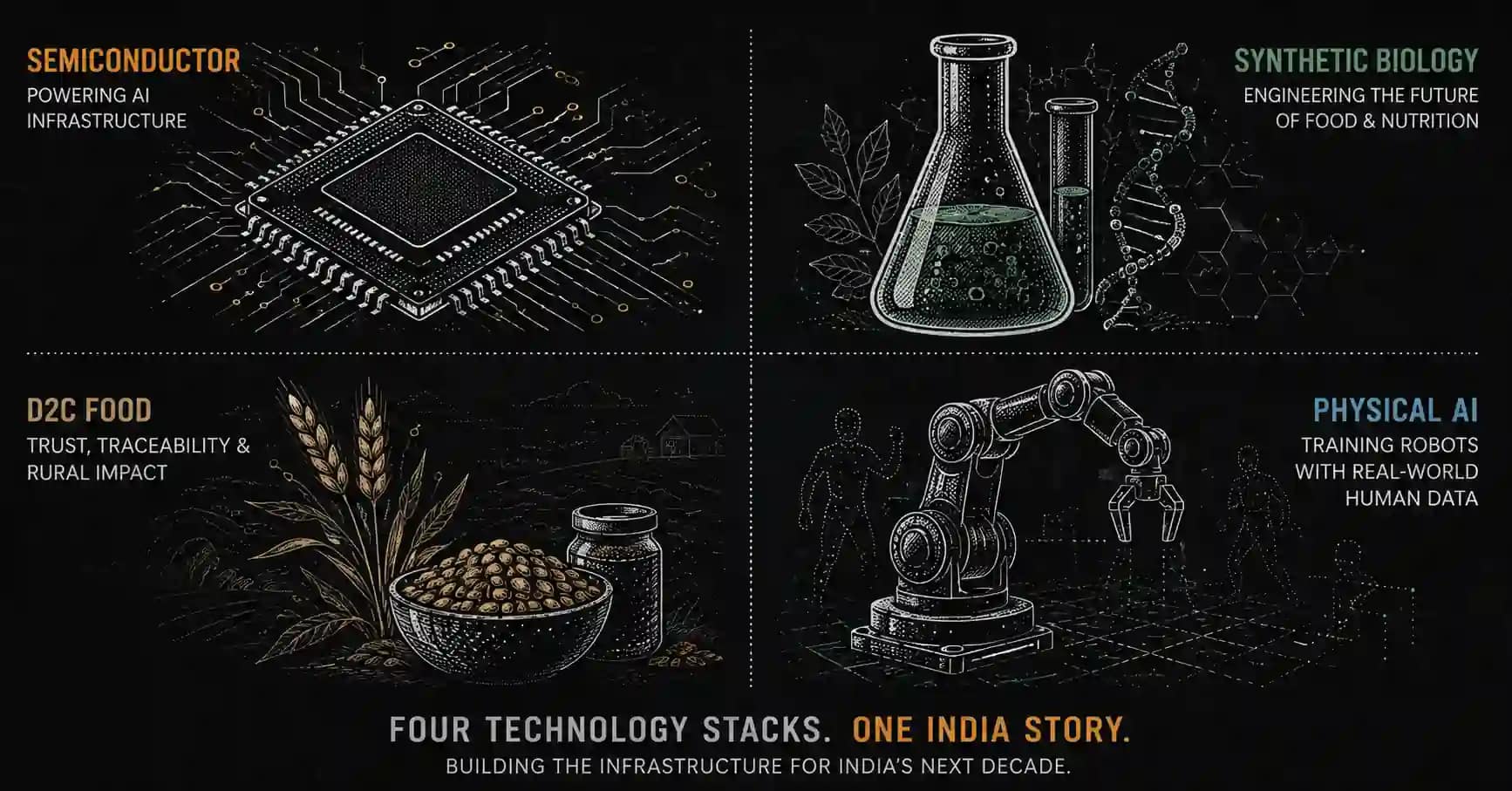
Inside that $130 million are four stories that would have been buried under any mega-round. An Indian semiconductor startup solving AI data centre power delivery raised from Japan’s TDK — a company that builds the physical components inside every major computing system on earth. A synthetic biology startup in Bhopal exited three years of stealth with a $13 million raise. A rural-food D2C brand doubled its valuation to ₹846 crore with IFC writing a cheque. And an AI training data startup from Berkeley chose India’s gig economy as the raw material for teaching the world’s robots how to move.
May 2026 full-month close: India raised approximately $630 million across confirmed deals in May 2026. Strip out Rapido’s $240M and the underlying ecosystem moved $390 million across 60+ deals — a pace that is consistent, healthy, and sector-diverse. This final week of May is the most representative snapshot of what the real market looks like when no single outlier dominates the headline.
Funding snapshot May 26–31, 2026
| Startup | Sector | Amount | Stage | Lead Investor(s) |
|---|---|---|---|---|
| C2i Semiconductors | Semiconductor | $16.7M | Series A Ext. | TDK Ventures, Peak XV Partners |
| Fairdeal.Market | B2B Commerce | $15M | Series A | Bertelsmann India Investments, WaterBridge, Incubate Fund Asia |
| StrainX Bioworks | Synthetic Biology | $13M | Series A | Prime Venture Partners, Leo Capital |
| Anveshan | D2C Food | ₹121 Cr (~$12.7M) | Series B | Vertex Ventures, IFC, Titan Capital, Wipro Enterprises |
| Tiea Connectors | Precision Mfg | ₹77 Cr (~$9.1M) | Series A | IvyCap Ventures, Jamwant, 8X Ventures |
| Human Archive | Physical AI Data | $8.2M | Seed | Wing Venture Capital, NVP Capital, Y Combinator |
| abcoffee | Coffee QSR | ₹61 Cr (~$7.2M) | Pre-Series B | Kliff Ventures |
| Yes Madam | Home Services | ₹50 Cr (~$5.9M) | Series A | Info Edge Growth Fund |
| Yoho | D2C Footwear | ₹23 Cr (~$2.7M) | Growth Round | Gulf Islamic Investments, Rajeev Misra |
| ZeroDrag | Drone Avionics | ₹6.5 Cr (~$770K) | Seed | Transition VC |
| Flexprice | SaaS / Billing | $1.5M | Seed | Undisclosed |
| Eazzy | Home Services | $440K | Angel | Industry founders + corporate angels |
| + Quantum Tiger AI (pre-seed, undisclosed) · Pramatra Space (undisclosed) · GIVA (undisclosed) · Bucketlistt (undisclosed) · Non-funding: Byju Raveendran sentenced 6 months by Singapore court · PhysicsWallah ₹120Cr internal investment into FinZ Finance NBFC · Nandan Nilekani anchors ₹2,000Cr Physis Capital AI + deeptech fund | ||||
🏆 Largest: C2i $16.7M
🧬 Biotech: StrainX $13M
🌾 Food: Anveshan ₹846Cr val
🤖 Physical AI: Human Archive
Where The Capital Went
Semiconductor
$16.7M
B2B Commerce
$15M
Synthetic Biology
$13M
D2C Food
$12.7M
Precision Mfg
$9.1M
Physical AI Data
$8.2M
Coffee QSR
$7.2M
Home Svcs + Others
~$10M
India Startup Funding analysis May 26–31, 2026
1. C2i Semiconductors — $16.7M Series A Extension | Semiconductor / AI Infrastructure
A Bengaluru startup founded in 2024 by six former Texas Instruments engineers just raised $16.7 million from TDK — the Japanese electronics giant whose components sit inside every smartphone, electric vehicle, and data centre on earth. That investor-startup pairing tells you everything you need to know about what C2i is building and why it matters.
C2i Semiconductors solves the “last-inch” power delivery problem for AI data centres. As next-generation GPUs from Nvidia, AMD, and Intel push toward 1,000W, 2,000W, and eventually 4,500W per chip by the end of the decade, the voltage regulator that sits between the power supply and the processor becomes a critical bottleneck. Incumbent solutions top out at 94% power conversion efficiency. C2i’s software-defined voltage regulator delivers over 96% — a 2-percentage-point improvement that translates to $12 million in annual energy savings per 100MW data centre.
Peak XV Partners participating alongside TDK Ventures is also significant. This is now the third semiconductor deal Peak XV has touched in May 2026 — following HrdWyr and BigEndian. The fund is systematically building a semiconductor portfolio at a moment when India’s chip design ecosystem is going from zero to real in a single quarter.
→ Strategic implication: India now has three chip design startups funded in a single month — BigEndian ($6M), HrdWyr ($13M), and C2i ($16.7M). The sector is no longer one interesting startup. It is a pattern. TDK’s entry as a strategic investor — not just financial — means C2i has a direct channel into global hardware supply chains from day one. For other semiconductor founders: this is the moment to be raising, not waiting.
2. StrainX Bioworks — $13M Series A | Synthetic Biology / Precision Fermentation
A startup from Bhopal — not Bengaluru, not Mumbai, not Delhi — just raised $13 million for synthetic biology. That geography alone is a signal worth noting.
StrainX Bioworks was founded in 2023 by IIT Delhi alumni Akshay Mittal and Dr. Alok Malaviya. The company builds precision fermentation infrastructure — using engineered microorganisms in industrial fermenters to produce high-value food and nutritional ingredients at scale. After three years of stealth, it exited with verified 10,000-litre fermentation runs and US self-GRAS certification for one molecule already secured.
The investor composition is exceptional. Prime Venture Partners co-led alongside Leo Capital — two of India’s most technically rigorous early-stage funds. Good Startup, the fund known for backing Impossible Foods and Perfect Day globally, also participated. That global synthetic biology pedigree sitting alongside India-specialist VCs signals that StrainX has been evaluated against the highest international benchmarks — and passed.
What StrainX is building addresses a structural problem in India’s food system: the country is the world’s largest consumer of several commodity ingredients — edible oils, dairy derivatives, flavour compounds — but almost entirely dependent on agricultural supply chains for them. Precision fermentation decouples ingredient production from agriculture, creates controllable quality, and dramatically reduces land and water use. The global market for fermentation-derived food ingredients is projected to exceed $50 billion by 2030.
→ Strategic implication: StrainX is the first Indian precision fermentation company to raise a meaningful Series A. It will not be the last. Founders in synthetic biology, alternative proteins, and fermentation-derived ingredients should use StrainX’s round as a signal that India’s VC ecosystem is now technically capable of evaluating deep biotech at the Series A stage. The stealth-to-raise playbook StrainX used — three years of quiet execution before any external capital — is a model worth studying.
3. Anveshan — ₹121 Cr (~$12.7M) Series B | D2C Food / Rural-Tech
The angel investor list in Anveshan’s ₹121 crore Series B reads like a who’s-who of India’s consumer economy: boAt co-founders Aman Gupta and Sameer Mehta, Swiggy co-founder Sri Harsha Majety, and Wipro Enterprises as an institutional participant alongside Vertex Ventures and IFC. That cap table is not assembled by accident — it is a deliberate signal about what Anveshan is and where it is going.
Founded in 2020 by Anuj Rakyan and Rishabh Chopra, Anveshan sells minimally processed food — A2 ghee, cold-pressed oils, raw honey, and wood-pressed mustard oil — sourced directly through a village-based micro-entrepreneur model. The company sources from 8,000+ farmers across 200+ villages and has built a direct-to-consumer brand on a thesis that India’s urban middle class will pay a premium for food it can trace back to a specific village and farmer.
The valuation tells the growth story. Series A was ₹430 crore. Series B is ₹846 crore — almost exactly 2x in approximately 18 months. IFC’s participation is particularly meaningful: the International Finance Corporation does not write cheques into Indian consumer startups casually. Its presence signals that Anveshan’s rural supply chain model has been evaluated as both commercially viable and developmentally significant — a combination IFC specifically looks for.
→ Strategic implication: Anveshan’s angel cap table — consumer brand founders, food delivery founders, and enterprise investors simultaneously — is a template for D2C food brands targeting India’s trust-conscious premium consumer. If your brand can credibly tell a traceability story and build a rural supply model that creates farmer income, you are now pitching into a category with live institutional validation from IFC, Vertex, and India’s most prominent consumer operators.
4. Human Archive — $8.2M Seed | Physical AI Training Data
This is the most globally significant India deal of the week — and almost no one covered it.
Human Archive raised $8.2 million from Wing Venture Capital, NVP Capital, and Y Combinator, with angels from OpenAI, Nvidia, Google, and Meta. Founded by UC Berkeley and Stanford students — Samay Maini, Rushil Agarwal, Shloke Patel, and Raj Patel — the company uses India’s gig economy to collect physical-world action data for training robots and physical AI systems.
Here is why this matters. The next generation of AI is not just software — it is physical. Robots, autonomous vehicles, and embodied AI systems need to learn how humans move, pick, place, sort, and navigate in the real world. That training data does not exist at scale. Human Archive is building the infrastructure to collect it — using India’s enormous, underemployed gig workforce as the source. The company pays Indian workers to perform everyday physical tasks while wearing sensors that record every movement with precision.
The investor list confirms the thesis. Angels from OpenAI, Nvidia, Google, and Meta are not backing this company as a financial bet. They are backing it because they know exactly what training data bottlenecks exist in their own physical AI pipelines — and they want a direct line to the solution.
→ Strategic implication: India is being chosen as the epicentre of physical AI data collection because of its gig worker scale, cost efficiency, and linguistic diversity. This is a new category of India-as-infrastructure — not just software services, not just IT outsourcing, but India’s human capital as the training ground for global robotics. Founders building in labour platforms, gig work management, or data collection infrastructure should be watching Human Archive’s growth closely.
3 Investor Behaviour Patterns This Week
PATTERN 01 Peak XV is systematically building a semiconductor portfolio — three chip deals in one month
Peak XV Partners participated in HrdWyr (Series A, $13M), and C2i Semiconductors (Series A extension, $16.7M) in May 2026, following its BigEndian involvement earlier. Three semiconductor investments in a single month from one fund is not opportunistic deal flow — it is a deliberate portfolio construction decision. Peak XV is building a chip design cluster. For founders in semiconductor design, VLSI, power electronics, and AI chip architecture, Peak XV is now the most active institutional fund in your category in India. That is the call to make this week.
PATTERN 02 Strategic corporates are replacing pure financial VCs as the most valuable Series B co-investor
Anveshan’s ₹121 crore Series B had Wipro Enterprises, IFC, and consumer-founder angels alongside Vertex Ventures. Dil Foods had Bikaji Foods Family Office last week. C2i had TDK Ventures — a corporate VC. The pattern is consistent: at Series B, the most valuable co-investor is no longer a pure financial VC. It is a strategic entity that brings distribution relationships, category credibility, or supply chain access. Founders approaching Series B should be identifying which corporates have strategic reasons to back them — not just which VCs have capital available.
PATTERN 03 India is being chosen as the operational base for global physical AI infrastructure — not just software
Human Archive is not an Indian startup selling to India. It is a global startup that chose India as its operational base for collecting physical AI training data — because India has the gig worker scale, the cost efficiency, and the infrastructure needed for what the global robotics industry requires. This is a new framing of India’s role in the global technology economy. Previously India was: IT services, software exports, consumer market. Now it is becoming: physical AI training ground, semiconductor design hub, synthetic biology manufacturing base. This week confirmed all three simultaneously.
The Deal Most People Missed
⚑ Underreported Signal
Nandan Nilekani anchors ₹2,000 Crore Physis Capital AI + Deeptech Fund
Every publication covered C2i and StrainX. Almost nobody led with the most consequential capital event of the week: Nandan Nilekani — the architect of Aadhaar, co-founder of Infosys, and arguably India’s most credible technology infrastructure builder — anchoring a ₹2,000 crore fund from Physis Capital targeting AI and deeptech startups.
A ₹2,000 crore dedicated AI and deeptech fund with Nilekani’s anchor is not just capital — it is a legitimacy signal of the highest order. Every LP in India who was uncertain about deploying into AI startups will look at Nilekani’s participation and reconsider. Every founder building in AI infrastructure who previously could not access large institutional cheques now has a new fund with enormous credibility and a specific mandate to find them.
The timing is deliberate. Nilekani’s fund launch coincides with the government’s India AI Mission, the semiconductor policy acceleration, and a private market that is clearly rotating toward hard technology. Physis Capital will not just write cheques — it will shape the narrative around which AI and deeptech categories are considered fundable in India for the next five years.
Non-Funding Signals That Matter
Byju Raveendran — Singapore court sentences 6 months
A Singapore court sentenced Byju Raveendran to six months in absentia for contempt related to BYJU’s creditor dispute. The case involves a $533 million loan from US-based lenders and the alleged misappropriation of funds. This is not just a legal footnote — it is the formal legal conclusion to India’s most visible startup failure, and it will shape how global lenders structure covenants for India-based startup debt for years. Every founder considering venture debt should study this case carefully.
PhysicsWallah — ₹120 Cr internal investment into FinZ Finance NBFC
PhysicsWallah invested ₹120 crore from its own balance sheet into FinZ Finance — an NBFC it controls — to fund student education loans. This is not a startup funding round. It is a company using retained capital to build a financial services vertical internally. The strategic logic is clear: PW has millions of students, many of whom need financing for courses. Building the lending infrastructure internally captures the full economic value of that relationship. Watch for more edtech companies following this playbook — education + embedded finance is the next category convergence.
May 2026 — Final Month Scorecard
May Total Capital
Confirmed rounds
Total Deals
Across 4 weeks
Chip Raises
BigEndian · HrdWyr · C2i
Spacetech Unicorns
Skyroot $1.1B · Agnikul $500M
May 2026 will be remembered as the month India’s startup ecosystem stopped being primarily a consumer internet story and became a hard technology story. Three semiconductor raises. Two spacetech unicorns. One synthetic biology company out of stealth. One physical AI training data platform choosing India as its operational base. One government fund disbursement to a private spacetech startup. One ₹2,000 crore deeptech fund anchored by India’s most credible technology builder.
The consumer plays were still there — Scapia’s $63M, Anveshan’s doubling valuation, Pronto’s home services momentum. But for the first time in years, the capital intelligence story of a full month in India was dominated by deep infrastructure, not consumer apps. That shift — if it continues into June and Q3 — will define the character of India’s startup ecosystem for the next five years.
What This Week Means For Founders
→
→
→
→
→
What To Watch — June 2026 Opening Week
▸
Zepto UDRHP: The clock from SEBI’s May 8 observation letter is running. Updated DRHP with FY26 financials expected by late June. Any revenue or loss disclosure resets quick-commerce peer valuations across private markets instantly.
▸
Physis Capital first investments: Nilekani’s ₹2,000 crore fund is operational. Its first announced investments will define its sector focus and ticket size preferences — high signal for the entire AI and deeptech ecosystem.
▸
Peak XV semiconductor portfolio: Three chip investments in May. Will June see a fourth? Any new semiconductor raise with Peak XV participation confirms intentional portfolio construction — not coincidence.
▸
Acko IPO bankers: ICICI Securities, Morgan Stanley, and Kotak are reportedly being appointed for Acko’s $2–2.5B IPO. Any formal mandate announcement unlocks the insurtech IPO narrative for H2 2026.
▸
StrainX and C2i MCA filings: Both rounds will generate PAS-3 filings within 30 days. Watch for any changes to disclosed round sizes or investor composition once MCA records are public.
Frequently Asked Questions
How much funding did Indian startups raise in the week of May 26–31, 2026?
Indian startups raised approximately $130 million across 18 confirmed deals during May 26–31, 2026. With no deal above $17M, this was the most evenly distributed week of May 2026 — capital spread across semiconductor AI chips, synthetic biology, D2C food, B2B commerce, physical AI data, precision manufacturing, and home services.
Which Indian startup raised the most funding in May 26–31, 2026?
C2i Semiconductors raised the largest round — $16.7 million in a Series A extension led by TDK Ventures, with Peak XV Partners participating. C2i builds software-defined voltage regulator platforms for AI data centres, delivering over 96% power conversion efficiency and $12 million in annual energy savings per 100MW data centre.
order:3px solid #888;”>
What is C2i Semiconductors and what does it do?
C2i Semiconductors is a Bengaluru-based deeptech startup founded in 2024 by former Texas Instruments engineers. It builds software-defined voltage regulator platforms for AI data centres — solving the last-inch power delivery challenge as next-generation GPUs demand up to 4,500W by late decade. Its $16.7M Series A extension was led by TDK Ventures with Peak XV Partners participating.
What did StrainX Bioworks raise and what does it do?
StrainX Bioworks raised $13 million in a Series A co-led by Prime Venture Partners and Leo Capital. Founded by IIT Delhi alumni in Bhopal, StrainX builds precision fermentation infrastructure — producing high-value food and nutritional ingredients using engineered microorganisms. It completed verified 10,000-litre fermentation runs and holds US self-GRAS certification for one molecule.
What did Anveshan raise in May 2026?
Anveshan raised Rs 121 crore (approximately $12.7 million) in a Series B led by Vertex Ventures, with IFC, Titan Capital, and Wipro Enterprises participating. Angels including boAt co-founders and Swiggy co-founder also participated. The round values Anveshan at Rs 846 crore — nearly 2x its Series A valuation of Rs 430 crore.
What is Human Archive and why did it raise funding in India?
Human Archive is a physical AI training data startup that uses India’s gig economy workers to collect real-world action data for training robots. Founded by UC Berkeley and Stanford students, it raised $8.2 million from Wing Venture Capital, NVP Capital, Y Combinator, and angels from OpenAI, Nvidia, Google, and Meta. India was chosen for its gig worker scale and cost efficiency for physical data collection.
Which sectors attracted the most startup investment in India in May 26-31, 2026?
Semiconductor and AI infrastructure led by deal size (C2i $16.7M). B2B commerce attracted $15M (Fairdeal.Market). Synthetic biology and food-tech combined for $25.7M (StrainX $13M + Anveshan $12.7M). Physical AI data infrastructure (Human Archive $8.2M), precision manufacturing (Tiea $9.1M), coffee QSR (abcoffee $7.2M), and home services (Yes Madam $5.9M) rounded out the week.
Who are the most active investors in Indian startups this week?
TDK Ventures and Peak XV Partners co-led C2i Semiconductors ($16.7M). Bertelsmann India Investments led Fairdeal.Market ($15M Series A). Vertex Ventures led Anveshan (Rs 121Cr Series B). Prime Venture Partners and Leo Capital co-led StrainX ($13M). Wing Venture Capital and Y Combinator backed Human Archive ($8.2M). Info Edge Growth Fund led Yes Madam (Rs 50Cr Series A). IvyCap Ventures led Tiea Connectors (Rs 77Cr Series A).
Related on Drudhh
→ May 12-18: Rapido at $3B — The Rest Told a Different Story
Sources: TechCrunch · YourStory · Inc42 · Entrackr · Business Standard · StartupTalky · DealStreetAsia · Moneycontrol · Opportunity India · Newskart · Bhavya Sharma funding desk · Company announcements · MCA filings
Capital intelligence report — not investment advice. All figures from verified public sources. Undisclosed amounts marked accordingly.
© 2026 Drudhh.com · Capital Intelligence for India’s Startup Ecosystem