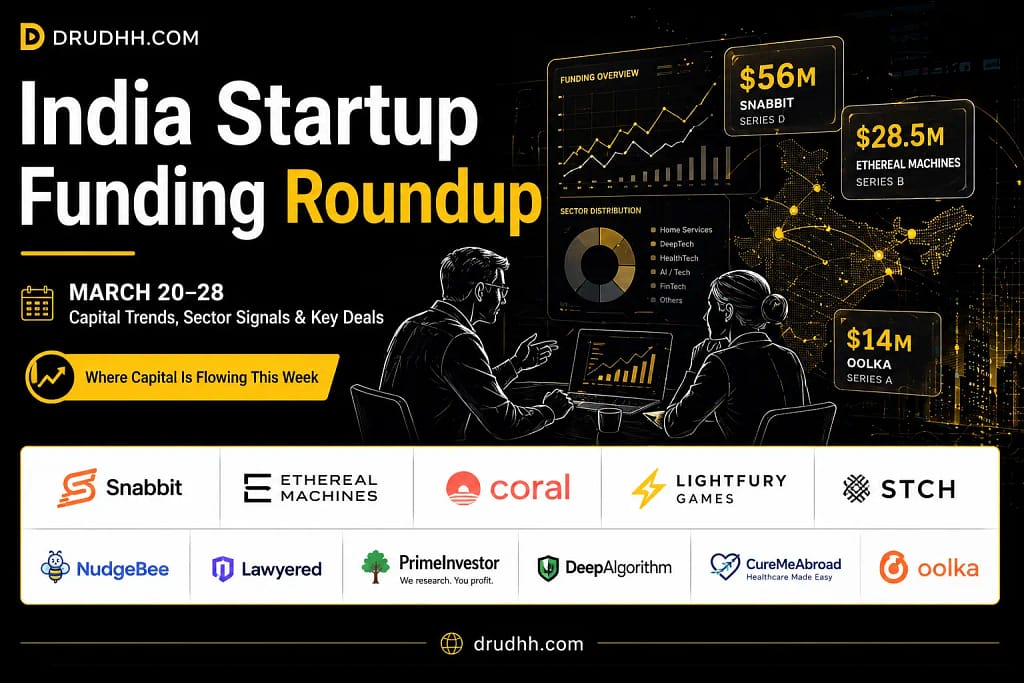
🇮🇳 India Startup Funding Apr 20–28, 2026
Why More Money Doesn’t Mean Easy Money ?
At first glance, this week looks strong.
Big deals, Multiple sectors. Over $150M+ capital deployed.
But here’s the real story:
- Money is flowing—but only into clear, scalableand strucutred systems
- Not into experiments anymore
This is not a funding boom .This is a filtering phase.
TL;DR
| Metric | Insight |
|---|---|
| Total Funding | ~$150M+ |
| Total Deals | 15+ |
| Dominant Sectors | AI, DeepTech, Gaming, FinTech |
| Stage Trend | Growth + Strong Seed Activity |
| Capital Signal | “Execution > Idea” |
📊 This Weekly funding Capital Signal
Home Services & DeepTech dominated capital flow,
signaling a clear investor shift toward real-world infrastructure + industrial tech
over pure SaaS plays.
reinforcing strong investor conviction in scalable home services platforms.
capital concentration is still skewed toward select sectors.
Early-stage funding remains cautious and fragmented.
Why Healthians Is Scaling Faster Than Competitors 🚀
While funding patterns show selective capital flow, Healthians is quietly
building a strong execution edge in diagnostics — something most miss at first glance.
1️⃣ Oolka — The “Brain” Behind Lending Decisions.
- How does Oolka make money if it doesn’t give loans itself?
- Let’s simplify this.
- Banks don’t fail because they don’t have money.
- They fail because they give money to the wrong people.
- That’s the real problem.
The Real Problem
In India, millions of people:
- Don’t get loans
- Or get loans at wrong interest rates
Why?
👉 Because lenders don’t understand risk properly
⚙️ The Working Model (The Engine)
Oolka builds:
AI systems that decide
- Who should get a loan
- At what risk
Flow:
User Data → AI Analysis → Risk Score → Lender Decision
They don’t lend.
They enable smarter lending
Unit Economics (Simple View)
- Cost: Data + AI infrastructure
- Revenue: From banks/NBFC partnerships
More data = better prediction = higher value
Drudhh.com Reality Check
Biggest Risks:
- RBI regulations can change fast
- Wrong predictions = financial losses
👉 This is a high-stakes game
2️⃣ Snabbit — The Hidden Economy of Home Services
Why is a home service startup raising $56M?
Because this market is broken.
The Real Problem
Every time you call:
- Electrician
- Plumber
👉 You face uncertainty
Working Model
Snabbit acts like:
👉 A middle layer
Customer ↔ Platform ↔ Service Provider
They earn via commission.
Unit Economics
- Cost: Acquisition + service quality
- Revenue: Per booking
👉 Repeat customers = profit
Reality Check
Biggest Risks:
- Quality control at scale
- Low margins
This is NOT a tech business
This is an operations business.
3️⃣ Ethereal Machines — India’s Manufacturing Comeback.
❓ Why are investors betting on manufacturing again?
Because India wants to build, not just sell.
Problem
Precision manufacturing is:
- Expensive
- Slow
Model
Ethereal builds:
👉 Advanced CNC + precision systems
Used in:
- Aerospace
- Defence
- High-end manufacturing
Unit Economics
- High cost machines
- High margin clients
👉 Fewer customers, bigger contracts
Reality Check
Risks:
- Capital intensive
- Long sales cycles
👉 This is a slow but powerful game
4️⃣ Gaming Cluster — Lightfury & Spill Games
❓ Why is gaming still getting funded?
Because attention = money.
Problem
People want:
- Entertainment
- Escape
Model
- Free games
- Earn via ads / in-app purchases
Unit Economics
- Cost: User acquisition
- Revenue: Lifetime value
👉 If LTV > CAC → profit
Reality Check
Risks:
- User retention
- Hit-driven industry
👉 One hit = success
👉 One miss = collapse
5️⃣ STCH — Fixing Textile Supply Chains
❓ Why invest in an “old industry”?
Because broken systems = opportunity
Problem
- Delays
- Middlemen
- Inefficiency
Model
Digitise sourcing + logistics
Unit Economics
- Low margins
- High volume
Reality Check
Adoption slow hoga
But moat strong ban sakta hai
6️⃣ Lawyered & Prime Investor — Trust Platforms
❓ What are these startups really selling?
Not product
Trust
Model
- Platform + advisory
- Monetisation via services
Reality Check
Building trust gonna take time
But once built = strong moat
Investor Sentiment Analysis
3 clear signals:
1. Big money = selective
Only proven models
2. Seed funding = alive
Experimentation still happening
3. AI is everywhere
But utility-driven, not hype
The Real Market Truth
Funding is NOT down.
👉 Stupidity funding is down
This Week’s Capital Signal
👉 “If you can’t explain your business simply, you won’t get funded.”
Final Thought
This week teaches one thing:
👉 Capital is not emotional anymore
👉 It is logical
❓ Now Think
If you had to pitch your startup today—
👉 Can you explain
how you make money in 30 seconds?
India Startup
Funding Roundup
March 20–28
Capital Trends & Sector Signals
Key Deals
Where Capital Is Flowing This Week
$28.5M
$14M
$2.5M
Startup Funding FAQs (India – April 2026)
1. How much total startup funding was recorded in India in April 2026?
In April 2026, Indian startups collectively raised over $150M+ in tracked weekly deals, reflecting steady capital flow despite an overall cautious funding environment.
2. Which sectors are leading startup funding in India in 2026?
AI, DeepTech, FinTech, Gaming, and Home Services are currently leading sectors. AI and deeptech are attracting the highest investor attention due to strong scalability and real-world applications.
3. Is startup funding increasing or decreasing in 2026?
Overall funding has slightly declined year-on-year, with Indian startups raising around $10–11B in FY2026. However, capital is becoming more selective and focused on high-quality startups. :contentReference[oaicite:0]{index=0}
4. Which sector is growing the fastest in terms of funding?
Artificial Intelligence and DeepTech are the fastest-growing sectors in 2026, driven by demand for automation, defense tech, and industrial innovation. :contentReference[oaicite:1]{index=1}
5. Are early-stage startups still getting funding in India?
Yes, early-stage funding is still active and even growing, with billions deployed in seed and Series A rounds. However, investors are focusing on strong execution and clear business models. :contentReference[oaicite:2]{index=2}
6. What is the biggest funding trend in India right now?
The biggest trend is a shift from idea-based funding to execution-based funding. Investors are backing startups with proven traction, revenue clarity, and scalable systems.
7. Which sectors are losing investor interest?
Pure-play SaaS and experimental consumer startups are seeing reduced investor interest compared to infrastructure-driven sectors like deeptech, EV, and AI-enabled platforms. :contentReference[oaicite:3]{index=3}