Fintech · Discount Broking 100% Bootstrapped Unicorn · ₹64,800 Cr Est. Founded 2010 Bengaluru
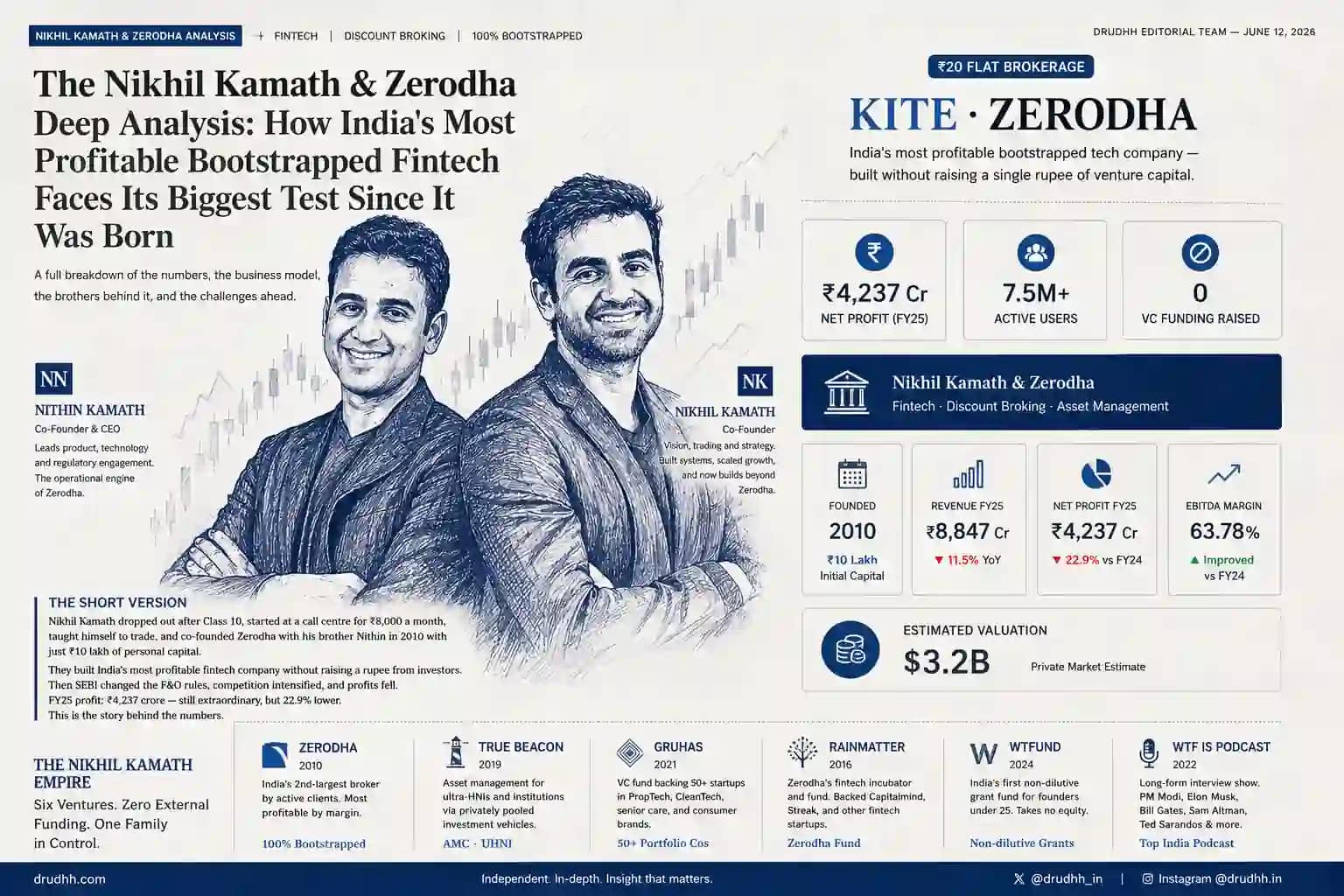
The Nikhil Kamath & Zerodha Analysis 2026: How India’s Most Profitable Bootstrapped Fintech Faces Its Biggest Test Since It Was Born
A full breakdown by Drudhh Editorial Team — June 12, 2026
₹20 FLAT BROKERAGE
KITE · ZERODHA
India’s most profitable bootstrapped tech company — built without raising a single rupee of venture capital.
₹4,237 Cr
Net Profit (FY25)
7.5M+
Active Users
0
VC Funding Raised
Nikhil Kamath & Zerodha
Fintech · Discount Broking · Asset Management
Founded
2010
₹10 Lakh Initial Capital
Revenue FY25
₹8,847 Cr
▼ 11.5% YoY
Net Profit FY25
₹4,237 Cr
▼ 22.9% vs FY24
EBITDA Margin
63.78%
▲ Improved vs FY24
Estimated Valuation
$3.2B
Private Market Estimate
The Short Version
Nikhil Kamath dropped out of school after Class 10, started at a call centre for ₹8,000 a month, taught himself to trade, and co-founded Zerodha with his brother Nithin in 2010 with ₹10 lakh of personal capital. They built India’s most profitable fintech company without raising a single rupee from venture capital — and for a decade, that looked like genius. Then SEBI changed the F&O rules, Groww overtook Zerodha in active clients, and Q2 FY25 brokerage revenue fell 40% year-on-year. FY25 profit: ₹4,237 crore — still extraordinary, but 22.9% lower. This is the analysis of what Zerodha actually is, how it got here, what Nikhil Kamath has built beyond it, and whether the bootstrapped empire can hold its ground in the most competitive era it has ever faced.
Who Built This — and Why
Two Brothers, ₹10 Lakh, and a Conviction That India’s Brokers Were Robbing Retail Investors
Zerodha Analysis by drudhh.com
NK
Nikhil Kamath — Co-Founder
Born 1986 · Shimoga, Karnataka · Class 10 dropout · 39.35% stake in Zerodha
Started trading at 17 while working at a call centre for ₹8,000/month. Built a systems-based approach to Indian equities that formed the foundation of his entire career. Co-founded Zerodha (2010), True Beacon (2019), Gruhas (2021), and WTFund (2024). India’s youngest self-made billionaire. Net worth: $3.2B (Forbes, April 2026).
NN
Nithin Kamath — Co-Founder & CEO
Zerodha CEO · 44.37% stake · Kamath family total: 84.37%
The operational engine of Zerodha. Leads product, technology, and regulatory engagement. Has been the public face of Zerodha’s communications — including transparent disclosures about revenue headwinds in FY25. Close collaborator with Nikhil on every major strategic decision since founding.
The founding story of Zerodha is less about a single lightbulb moment and more about an accumulating frustration with how India’s brokers extracted value from retail investors. A ₹1 lakh intraday trade on ICICI Direct in 2010 cost ₹275–₹500 in brokerage alone. Zerodha’s answer was surgical: ₹20 flat. No percentage. No negotiation. No exceptions.
They launched with ₹10 lakh of personal capital, no investors, no advisory board, and no PR. Nithin ran the operations; Nikhil ran the trading. The Kite platform — still widely considered India’s cleanest retail trading interface — was built in-house. Rainmatter, the fintech incubator, followed in 2016. By FY24, Zerodha had ₹9,993 crore in revenue and ₹5,496 crore in profit — making it more profitable per rupee of revenue than almost any Indian company of comparable scale, listed or unlisted.
Nikhil, meanwhile, kept building outward. True Beacon (2019) for ultra-HNI asset management. Gruhas (2021) for PropTech and CleanTech VC with Abhijeet Pai. WTFund (2024) — India’s first non-dilutive grant fund for founders under 25, taking no equity in return. And a podcast whose guest list by 2025 included Prime Minister Narendra Modi (his first-ever podcast appearance), Elon Musk, Sam Altman, Bill Gates, and Netflix CEO Ted Sarandos. The Kamath family still owns 100% of Zerodha.
The Nikhil Kamath Empire
Six Ventures. Zero External Funding. One Family in Control.
Zerodha
2010 · Co-founder · 39.35% stake
India’s 2nd-largest broker by active clients, most profitable by margin. ₹4,237 Cr profit FY25. 100% bootstrapped. Products: Kite, Coin, Console, Varsity, Kite Connect API.
Bootstrapped
True Beacon
2019 · Co-founder
Asset management for ultra-HNIs and institutions via privately pooled investment vehicles. Manages Indian market exposure for family offices and institutional allocators.
AMC · UHNI
Gruhas
2021 · Co-founder (with Abhijeet Pai)
VC fund backing 50+ startups in PropTech, CleanTech, senior care, and consumer brands. Two funds: GCCF (consumer) and Earth Fund (sustainability + PropTech, with Brigade Group).
50+ Portfolio Cos
Rainmatter
2016 · Via Zerodha
Zerodha’s fintech incubator and fund. Backed Capitalmind, Streak, and other fintech and sustainability startups. Operates as Zerodha’s strategic investment arm.
Zerodha Fund
WTFund
2024 · Founder
India’s first non-dilutive grant fund for founders under 25. Takes no equity. 20+ startups across fintech, edtech, climate, D2C backed in two cohorts as of 2025.
Non-dilutive Grants
WTF is Podcast
2022 · Host
Long-form interview show. PM Modi’s podcast debut was here (Jan 2025). Guests include Elon Musk, Bill Gates, Sam Altman, Ted Sarandos, Neal Mohan.
Top India Podcast
How This Business Actually Works
Flat ₹20 Per Trade Changed India’s Market — And Now That Very Model Is Under Pressure
Zerodha Business Model — Money Flow
Trader pays ₹20 flat / trade
→
Zerodha Platform Brokerage + Interest + AMC
→
NSE/BSE Settlement Trade executed
Interest Income Client margin float
Platform Margin 63.78% EBITDA est.
drudhh.com · Estimates based on RoC filings and industry benchmarks
Interest income (client margin float · lending)~22%
Fund mgmt & software (AMC fees · Kite Connect API)~15%
Other (DP charges · account services · misc)~8%
Drudhh estimates based on disclosed revenue mix and industry benchmarks. Not an exact figure.
The SEBI disruption. Zerodha’s F&O revenue dependence was its strength during the bull market of 2021–24, when retail derivatives volumes surged. SEBI’s 2024–25 regulations reduced weekly F&O expiries, raised transaction taxes, tightened margin norms, and increased capital requirements — measures designed to protect retail traders from speculative losses. The effect on Zerodha was direct: Q2 FY25 brokerage revenue fell 40% year-on-year. Nithin Kamath publicly acknowledged in October 2025 that Zerodha might be “forced to charge brokerage” on equity delivery — a statement that would have been unthinkable two years earlier, and signals just how much the regulatory environment has shifted the economics.
The Numbers — What We Know and What We Estimate
Still India’s Most Profitable Fintech. But the Trajectory Changed Direction in FY25.
FY23 Revenue ₹6,875 Cr +38% YoY
FY24 Revenue ₹9,993 Cr +45% YoY
FY25 Revenue ₹8,847 Cr −11.5% YoY
Zerodha Financial Dashboard — FY25
Metric
Value
Status
Notes
Revenue · FY25
₹8,847 Cr
Verified
−11.5% YoY · RoC filing
Net Profit · FY25
₹4,237 Cr
Verified
48% PAT margin · −22.9%
EBITDA Margin · FY25
63.78%
Verified
Improved from 55.25% FY24
Cash Reserves · FY25
₹22,679 Cr
Verified
Zero debt · 2× vs FY24
Valuation Estimate
₹64,800 Cr
Reported
Hurun India 2024 · Unlisted
Promoter Holding
100%
Verified
Nithin 44.37% · Nikhil 39.35%
Nikhil Kamath’s Personal Investment Portfolio (Key Holdings)
Company
Sector
Investment / Holding
Details
Nothing
Consumer Tech
$21M invested
Series C · $1.3B valuation
Goldi Solar
Clean Energy
₹137.5 Cr
Solar cell expansion
Ather Energy
EV · Listed
1.80% stake (~₹591 Cr)
Biopeak
Health Tech
$2.7M (lead)
Follow-on
Nazara Technologies
Gaming · Listed
Strategic holding
Long-term position
Rotoris
Deeptech
Part of $3M Seed
Who Else Is Playing This Game
Groww Overtook Zerodha. But “Largest” and “Most Profitable” Are Different Trophies.
Broker
Active Clients
NSE Share
Revenue (Latest)
Status
Groww
13M+ (Dec ’24)
26.3%
₹3,145 Cr FY24
IPO-bound
Zerodha ★
7.5M (2026 est.)
16%
₹8,847 Cr FY25
Bootstrapped
Angel One
7.58M
15.3%
₹4,286 Cr FY24
Listed · NSE
Upstox
2.75M
5.6%
~₹900 Cr est.
Tiger Global
Dhan
~1M
~2%
Early stage
Fastest growing
Active client market share — NSE FY25
Groww26.3%
Zerodha16%
Angel One15.3%
Upstox5.6%
Others (combined)36.8%
Zerodha remains far more profitable per client than Groww — ₹8,847 crore revenue from 7.5 million clients vs Groww’s ₹3,145 crore from 13 million. Zerodha generates nearly twice the revenue per active client. But revenue per client doesn’t determine who attracts India’s next generation of retail investors — and on that metric, Groww has won the last three years decisively. Drudhh’s honest take: Zerodha’s Kite is still the best trading platform in India for active F&O traders. That moat holds for 15–20% of the retail investing population. The vulnerability is the mutual-fund-first, SIP-oriented investor who defines the next decade — and that user chose Groww’s simpler interface over Kite’s power-user design.
The Size of the Prize
India Has 200 Million Potential Investors. The Industry Has Reached 50 Million.
India’s total demat account count crossed 180 million by early 2026, but active investors number roughly 50–55 million. The total addressable investing population — adults with smartphones and meaningful savings — is 200–250 million. Current platforms collectively reach only 25–30% of this base. India’s mutual fund AUM crossed ₹65 lakh crore in 2025, growing at roughly 20% per year. The retail investing market is expected to compound at 15–20% annually through 2030 as financial literacy improves and UPI-enabled account opening lowers the barrier to first investment.
For Zerodha, the largest opportunity is not recapturing clients lost to Groww — it is converting the 150 million uninvested Indians who have never opened a demat account. Zerodha Fund House’s AMC, the Nifty 50 ETF, and the BSE Sensex Index Fund launched in late 2025 are early signals of how Zerodha intends to pursue that market. The ₹22,679 crore cash fortress provides the runway to invest aggressively in this transition if it chooses to.
What Could Go Wrong
Six Risks That ₹22,679 Crore in Cash Cannot Fully Protect Against
High
SEBI — further F&O tightening
SEBI’s 2024–25 rules already cut Q2 FY25 brokerage by 40%. Further restrictions on the remaining monthly expiries or a cap on retail F&O participation could structurally shrink the primary revenue engine beyond recovery at current cost structures.
High
Groww’s structural lead in active clients
Groww’s 26.3% share vs Zerodha’s 16% is not a blip. Groww added 3.6M active clients in FY25; Zerodha lost 550,000. First-mover advantage in consumer investing platforms is durable — the next generation chose Groww first.
Medium
Free delivery model under existential pressure
Nithin Kamath warned in Oct 2025 that Zerodha may need to charge for equity delivery. If it does, price-sensitive users migrate. If it doesn’t, the revenue gap from declining F&O becomes structurally harder to fill.
Medium
F&O revenue concentration risk
Historically 50–60% of brokerage came from F&O. SEBI permanently repriced this. AMC fees, API subscriptions, and lending are growing but remain too small to offset the gap at FY24 revenue levels in the near term.
Medium
Nikhil’s multi-venture bandwidth split
Nikhil now runs True Beacon, Gruhas, WTFund, a top podcast, and manages a $3.2B personal portfolio simultaneously. As Zerodha faces its toughest cycle, the governance question of where his attention is concentrated is legitimate.
Low
Platform reliability — tech outages
Zerodha’s Kite experienced brief glitches in 2025 during high-volatility sessions. At 7.5M active users, even a 30-minute outage attracts regulatory attention and erodes trust among the power-trader base where Zerodha’s brand is strongest.
The Road Ahead
Three Possible Futures for a Company That Has Never Had to Fight for Its Life Before
Zerodha is actively diversifying: the Zerodha Fund House AMC launched Nifty 50 ETF and BSE Sensex Index Fund in late 2025. Kite Connect API subscriptions are growing. Zerodha Capital’s lending book expanded 3.2x in FY25. Groww’s upcoming IPO will create a public market benchmark for Indian retail fintech valuations that will likely force the Kamath brothers to revisit their own listing timeline. The next 18 months are the most consequential in Zerodha’s existence.
Bull Case
SEBI regulations stabilise. Zerodha Fund House AMC crosses ₹10,000 Cr AUM. Kite retains power traders. Groww’s IPO re-rates Zerodha’s value. Revenue recovery to ₹9,500+ Cr by FY27.
IPO at ₹80,000–90,000 Cr. Nikhil’s net worth crosses $5B. Bootstrapped empire fully justified.
Base Case
F&O volumes stay suppressed. Selective brokerage charges introduced. AMC and API fees partially offset losses. Active clients stabilise at 7–7.5M. Revenue flattens at ₹7,500–8,500 Cr.
IPO in 2027–28 at a more modest multiple. Profitable but no longer India’s most-admired fintech growth story.
Bear Case
Further SEBI F&O tightening. Groww and Dhan accelerate client acquisition. Zerodha fails to attract mutual-fund-first investors. Market share slips below 12%.
Revenue falls to ₹6,000–7,000 Cr by FY27. IPO shelved or significantly downvalued vs current ₹64,800 Cr estimate.
Drudhh’s Verdict
DRUDHH’S VERDICT — Nikhil Kamath & Zerodha
Zerodha is the most profitable company in Indian fintech that nobody fully controls — and Nikhil Kamath is the most underrated builder in a country obsessed with funding rounds.
The Case For
Zerodha’s ₹22,679 crore cash fortress and zero debt give it a cushion no VC-backed competitor can match. Even in a down year — FY25 revenue fell 11.5% — it printed ₹4,237 crore net profit at a 48% margin. No Indian consumer tech company of this scale has built that financial resilience. Nikhil Kamath’s empire beyond Zerodha — True Beacon, Gruhas, WTFund, a podcast whose guests include the sitting Prime Minister — is not distraction. It is the compounding of a network that makes the ecosystem harder to replicate. The Kamath family built for decades, not quarters, and the balance sheet is the proof.
The Case Against
Groww’s 26% market share vs Zerodha’s 16% is not a rounding error — it is a structural shift in who India’s next retail investors trust. The SEBI F&O squeeze permanently repriced the core revenue engine. And Zerodha has not shown it can attract the UPI-native, mutual-fund-first investor who will define Indian retail investing for the next decade. That user chose Groww. In consumer platforms, who wins the first login often wins the relationship for life.
Zerodha’s most likely future is a highly profitable, slightly smaller business — no longer India’s largest broker by clients, but still the most profitable per client, and the only brokerage with a balance sheet strong enough to weather a decade of regulatory headwinds. As for Nikhil Kamath: the dropout from Shimoga who interviewed Elon Musk and Narendra Modi in the same calendar year has built something India’s startup ecosystem rarely produces — real wealth, without a single rupee of venture capital, and an ecosystem around it that compounds independently of market cycles.
Frequently Asked
Everything You Need to Know About Nikhil Kamath and Zerodha
Who is Nikhil Kamath?
Nikhil Kamath (born September 5, 1986, Shimoga, Karnataka) is co-founder of Zerodha, True Beacon, Gruhas, and WTFund. He dropped out of school after Class 10, started trading Indian equities at 17 while working at a call centre, and built a $3.2 billion net worth (Forbes, April 2026) without any external venture capital. He holds 39.35% of Zerodha alongside his brother Nithin (44.37%).
How much is Zerodha worth?
Zerodha is unlisted. Its estimated valuation per the Hurun India Rich List 2024 is approximately ₹64,800 crore. The company is 100% Kamath family-owned. Zerodha has never raised external funding and has no outside shareholders.
What is Zerodha’s revenue and profit for FY25?
Zerodha reported operating revenue of ₹8,847 crore in FY25, down 11.5% from ₹9,993 crore in FY24. Net profit fell 22.9% to ₹4,237 crore. EBITDA margins improved to 63.78% and the company holds ₹22,679 crore in cash with zero debt, per RoC filings.
Why did Zerodha’s revenue fall in FY25?
SEBI’s 2024–25 derivatives regulations reduced weekly F&O expiries, tightened margin requirements, raised Securities Transaction Tax, and increased capital requirements for retail F&O trading. These cut Zerodha’s Q2 FY25 brokerage revenue by approximately 40% year-on-year, since F&O historically contributed 50–60% of total brokerage income.
Who are Zerodha’s main competitors?
Groww leads Indian retail broking with 26.3% active client market share, having overtaken Zerodha in 2024. Zerodha holds 16%. Angel One holds 15.3% and Upstox 5.6%. Dhan is the fastest-growing challenger. Traditional bank-backed brokers like ICICI Securities and HDFC Securities compete for full-service advisory clients.
How does Zerodha make money?
Zerodha charges a flat ₹20 per trade on intraday and F&O transactions, with equity delivery free. Additional revenue streams include interest income on client margin float, Kite Connect API developer subscriptions, Zerodha Fund House AMC management fees, and Zerodha Capital’s margin-against-securities lending business.
Is Zerodha planning an IPO?
No formal IPO timeline has been announced as of June 2026. Nithin Kamath has discussed the possibility publicly. Zerodha’s ₹22,679 crore cash reserve means no IPO is operationally necessary — any listing would be strategic. Groww’s upcoming IPO may accelerate the Kamath brothers’ decision.
What is Nikhil Kamath’s net worth?
Nikhil Kamath’s net worth is estimated at $3.2 billion (approximately ₹29,683 crore) as of April 2026, per Forbes. The majority comes from his 39.35% stake in Zerodha. Additional value comes from True Beacon, Gruhas, and personal holdings including Ather Energy (1.80% stake, ~₹591 crore value as of April 2026) and a $21M position in Nothing.
What is Zerodha’s market capitalization?
Zerodha does not have an official market capitalization because it is a privately held, unlisted company. Instead, its value is estimated through its implied private valuation, which is approximately ₹66,800 crore based on recent unlisted share prices
What is WTFund?
WTFund is a non-dilutive grant fund launched by Nikhil Kamath in 2024 for Indian founders under the age of 25. It takes no equity in return for funding — a model Nikhil describes as investing in talent rather than business plans. As of 2025, it has backed 20+ startups in fintech, edtech, climate tech, and D2C in two cohorts.
What is Drudhh’s analysis of Zerodha?
Drudhh views Zerodha as India’s most financially resilient fintech — exceptional margins, ₹22,679 crore cash, zero debt. However, Groww’s structural lead in active clients and SEBI’s F&O revenue squeeze are genuine threats to Zerodha’s long-term market position. The critical challenge: attracting the mutual-fund-first, UPI-native investor who will define Indian retail investing through 2030 — a cohort that currently chooses Groww over Kite.
What is Zerodha’s valuation in 2026?
As of 2026, Zerodha has not officially disclosed a new company valuation…
WEEKLY FUNDING ROUNDUP
India Startup Funding Weekly
Who raised capital? Which investors are becoming more aggressive? And what do this week’s funding rounds reveal about the direction of India’s startup ecosystem?
A research-driven breakdown of startup funding activity, investor behavior, sector momentum, founder signals, and capital trends shaping the Indian venture ecosystem.
Rejected by investors. Outspent by giants. Still built a multi-billion-dollar mobility company.
From bike taxis to becoming one of India’s most closely watched mobility startups, this analysis breaks down Rapido’s business model, funding journey, unit economics, competitive advantages, and the risks that could define its next decade.
By Lavish Pundir · Performance Marketer & Founder, Drudhh
Published: June 15, 2026. Last updated: June 12, 2026. Prepared by the Drudhh Editorial Team using RoC filings sourced via Entrackr and Datafin, Business Standard, Inc42, Forbes India, Wikipedia, and official company communications. All financial figures are from Registrar of Companies filings unless labelled “Estimated” or “Reported.” Drudhh operates independently with no advertiser relationships. This is editorial analysis, not investment advice.
About the Author
Lavish Pundir is a performance marketer and the founder of Drudhh, an independent publication focused on startups, venture capital, business models, funding, and growth. His research sits at the intersection of marketing, capital, and company-building, with a focus on understanding how businesses acquire customers, create competitive advantages, and scale over time.
ABOUT THE AUTHOR
Lavish Pundir
Performance Marketer · Founder & Editor, Drudhh
Lavish Pundir is a performance marketer and the founder of Drudhh, an independent publication focused on startups, venture capital, business models, funding, and growth.
His research sits at the intersection of marketing, capital, and company-building, with a focus on understanding how businesses acquire customers, create competitive advantages, and scale over time.
Published: June 15, 2026 Last updated: June 12, 2026
Prepared by the Drudhh Editorial Team using RoC filings sourced via Entrackr and Datafin, Business Standard, Inc42, Forbes India, Wikipedia, and official company communications.
All financial figures are from Registrar of Companies filings unless labelled “Estimated” or “Reported”.
Drudhh operates independently with no advertiser relationships. This publication is editorial analysis and should not be considered investment advice.