AI Funding India March 2026: Enterprise Wrote the Cheques. Nobody Noticed.
Beyond the billion-dollar hype of Neysa, institutional capital in March moved quietly into the infrastructure layers that actually build durable businesses.
What is AI startup funding in India? AI startup funding in India covers venture capital and private equity investment flowing into companies that build artificial intelligence products, infrastructure, or services — either for Indian enterprise use cases or for global markets from an Indian base. In 2026, this spans foundation model developers, AI cloud infrastructure builders, post-training data companies, and AI-native SaaS platforms.
The month that actually mattered in Q1 2026 was not March. February was — Neysa’s $1.2 billion round landed then, and it pulled every headline with it. March, by contrast, was quieter. Approximately $948 million in total startup funding across 111 deals, per Entrackr data. No single outlier. No billion-dollar distortion.
That is exactly what makes March worth reading carefully.
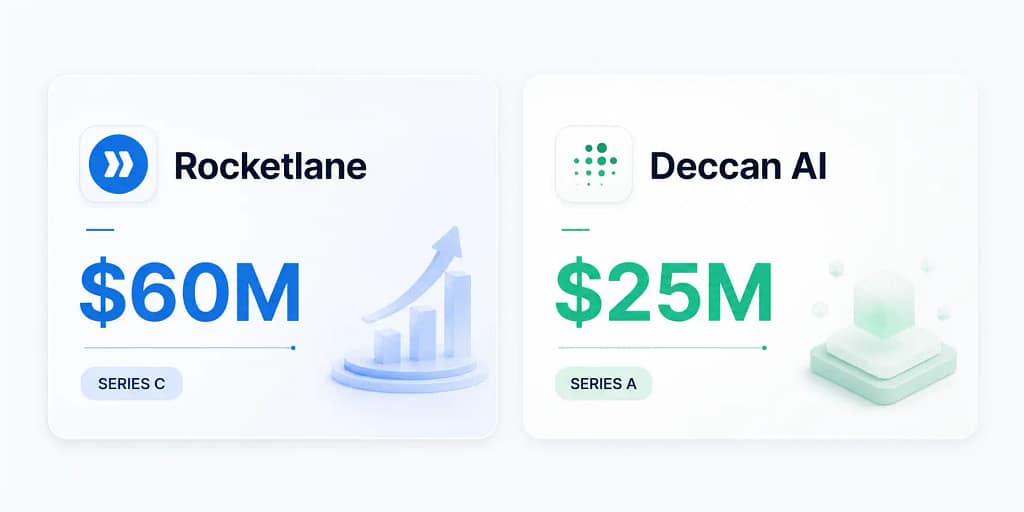
Strip away the mega-deal noise and what you see is where institutional investors are placing considered, deliberate bets on Indian AI. Two deals defined the month: Deccan AI’s $25 million Series A and Rocketlane’s $60 million Series C. Neither made front pages. Both carry more signal than their coverage suggested.
AI Funding India March 2026 — Key Numbers

Total startup funding in March 2026
The framing matters here. February’s $2 billion number was Neysa. Remove that one deal and February was unremarkable. March’s $948 million, spread across 111 deals with no single company distorting the average, is a healthier picture of where India’s AI funding actually stands. More deals, smaller tickets, more disciplined investors — that is a market in calibration, not decline.
For context: India’s overall startup funding fell approximately 26% year-on-year in Q1 2026 compared to Q1 2025, (per Inc42 data).AI bucked that trend. It grew 73% year-on-year in the same period. That divergence is not coincidence — it reflects a deliberate reallocation of institutional capital toward the one sector where product-market fit is hardening fastest.
Deal Breakdown — Where the Capital Actually Went
March’s disclosed AI deals fell into two clean sub-segments. Here is the full picture:
| Company | Amount | Stage | Lead Investor | Sub-sector |
|---|---|---|---|---|
| Rocketlane | $60M (≈₹504 Cr) | Series C | Insight Partners | AI-native professional services automation |
| Deccan AI | $25M (≈₹210 Cr) | Series A | A91 Partners | Post-training data and AI evaluation |
Sub-segment 1 — AI-native enterprise delivery
Rocketlane is a Chennai-founded company that builds professional services automation software. That description undersells what it actually does. The product manages what happens after an enterprise buys software — the implementation, configuration, documentation, and delivery phases that most companies still run across spreadsheets and email threads.
In March, Rocketlane launched Nitro alongside its fundraise — an agentic execution platform that embeds AI agents directly into services delivery. These agents do not just track work. They identify project risks early, rebalance resources in real time, and execute repeatable tasks like migrations and technical documentation. The company claims early Nitro deployments can reduce delivery effort by up to 50%.
Revenue doubled year-on-year. Average deal size grew 4.5 times since 2023. Customers include Intercom, Glean, and Notion — companies that are themselves AI-native. When AI-native companies choose your platform to manage their own implementation workflows, that is a strong endorsement of category maturity.
Sub-segment 2 — Post-training data and AI evaluation
Deccan AI is harder to categorise, which is probably why it received less coverage. It does not build AI products. It makes AI products better — by supplying the human-verified post-training data and evaluation infrastructure that frontier labs need once a model exists.
Its customers include Google DeepMind and Snowflake. Founded in late 2024, the company already serves approximately 10 enterprise clients across a couple dozen active projects at any given time. The work is highly specialised: generating expert feedback, running evaluations, building reinforcement learning environments — tasks that require domain expertise, not just data labelling at scale.
A91 Partners led the round. This is A91’s first-ever AI investment. They have historically backed Blue Tokai, Healthkart, Giva — consumer and financial services companies with proven revenue models. Their move into AI evaluation infrastructure in March 2026 is a deliberate call on where durable AI services revenue will concentrate.
What the Investor Composition Is Saying
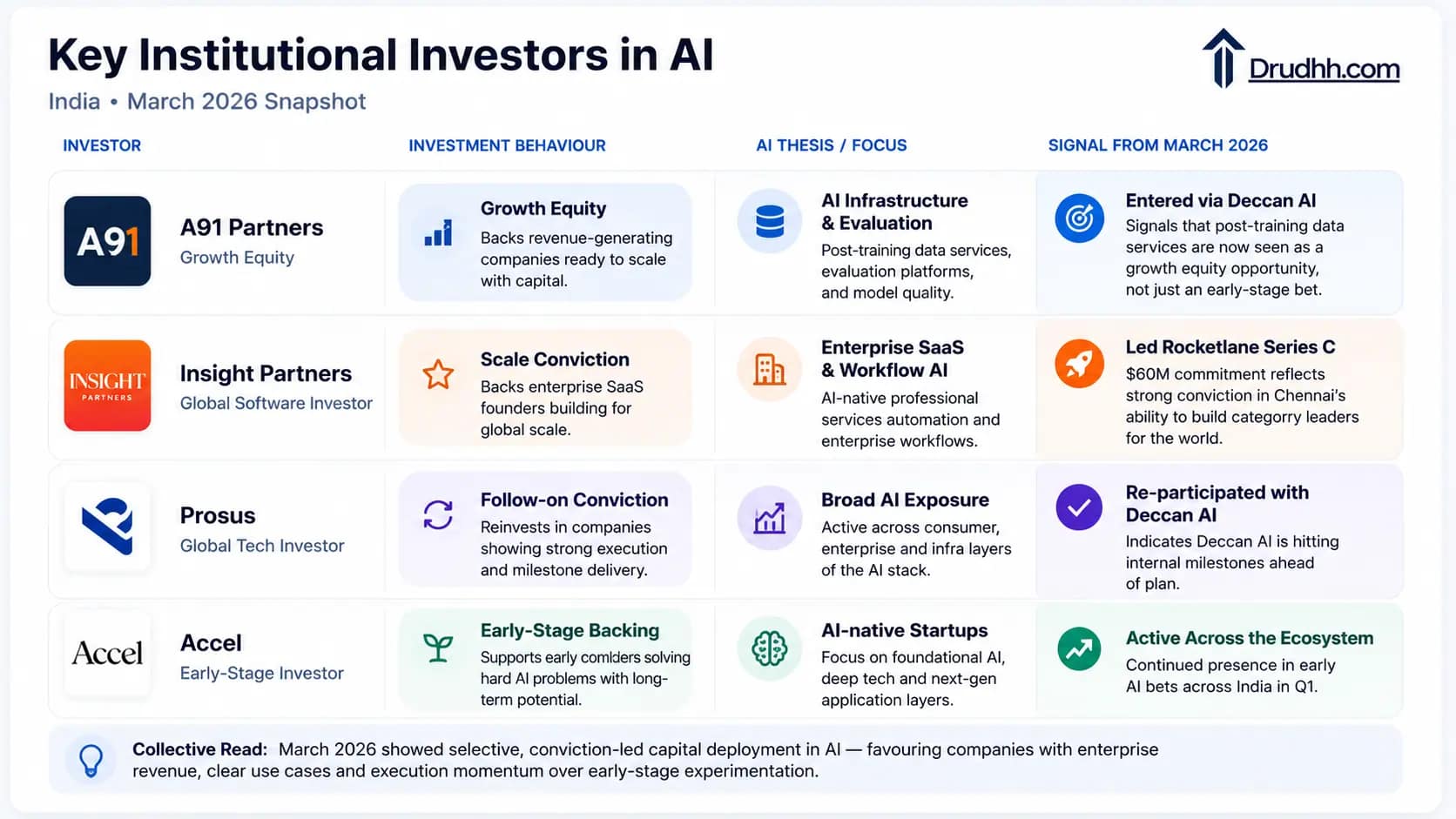
Three investor profiles showed up in March, and each carries a different message.
A91 Partners is a growth equity firm. Growth equity means they back companies that already have revenue, already have customers, and need capital to scale — not to find product-market fit. Their entry into AI via Deccan AI’s Series A tells you that at least one sophisticated institutional fund now sees post-training data services as a growth equity investment, not an early-stage bet. That is a significant maturity signal for the sub-segment.
Insight Partners is one of the few global software investors that consistently backs India-founded enterprise SaaS at scale. Their Rocketlane Series C confirms that they view Chennai as capable of producing global PSA category leaders — not just offshore delivery shops. The $60 million size matters too. That is not a hedge investment. It is a conviction bet.
Prosus appeared as a continuing backer in Deccan AI and stayed active across Q1’s broader AI deal flow. Prosus tends to double down on portfolio companies that show strong execution — their re-participation signals Deccan AI is hitting internal milestones ahead of schedule.
The collective read: institutional investors in March were not chasing AI as a theme. They were backing specific companies in specific sub-segments where enterprise revenue was already present and growing. That selectivity is healthy. It means the next wave of Indian AI funding will flow to companies that can show P&L, not just product demos.
The Sub-Segment Nobody Is Talking About
“
Post-training infrastructure is India’s quiet AI advantage — and almost no one is covering it.
Every conversation about Indian AI focuses on three things: foundation models (Sarvam, Krutrim), AI applications (fintech, healthtech, agritech), and AI cloud infrastructure (Neysa). The post-training layer — the companies that make models reliable after they are built — receives almost no editorial attention.
Deccan AI is building in this layer. But it is not alone. The broader category of AI evaluation, red-teaming, RLHF data generation, and model testing is a genuine industry in India, mostly invisible to mainstream startup coverage because the customers are American AI labs, not Indian enterprises.
Here is why this matters specifically for India. The concentration of AI model development in the US creates a structural demand for high-quality, specialised human evaluation work. India has the talent base — engineers, domain experts, researchers — to serve this demand at scale and with the quality consistency that frontier labs require. Deccan AI is building the infrastructure layer on top of that talent.
The company deliberately keeps its contributor base concentrated in India, unlike competitors who distribute across 100-plus countries. The reason is quality management — a smaller, better-monitored contributor pool produces more reliable model training data. That approach is replicable. Other Indian founders should be looking at adjacent niches in this layer: code evaluation, multimodal data generation, domain-specific RLHF for healthcare and legal applications.
This is not a services business. It is a quality infrastructure business. The distinction matters for how investors value it and how founders should pitch it.
What This Means for Founders in AI
Enterprise revenue before the raise, not after. Rocketlane doubled revenue before closing its Series C. Deccan AI had Google DeepMind as a customer before announcing its Series A. In March 2026, growth equity and late-stage investors are not writing cheques on the basis of AI potential — they are writing them on the basis of enterprise contracts already signed. If you are building toward a Series A or beyond, the question is not “what is your AI thesis” but “who is paying you, and how much did that grow last quarter.”
Sub-segment specificity beats broad AI positioning. Neither March deal was pitched as “we are an AI company.” Rocketlane is professional services automation with AI agents embedded. Deccan AI is post-training data and evaluation infrastructure. Both pitches are narrow enough to be defensible and large enough to be investable. Founders who position as “AI for X industry” without specifying the precise workflow or infrastructure layer they own will find it harder to differentiate in a crowded market.
Global customers validate faster than domestic pilots. Both companies serving global enterprise — DeepMind, Snowflake, Intercom, Glean — are using international customer logos to anchor their fundraises. Domestic enterprise pilots move slowly in India; global enterprise revenue closes faster and at higher ticket sizes. If your AI product can serve global customers from an Indian base, that is a fundraising argument, not just a revenue strategy.
The evaluation and quality layer is open territory. Deccan AI is one of the few companies explicitly building AI evaluation infrastructure in India. The market for model testing, red-teaming, RLHF data, and domain-specific evaluation is growing as enterprises move from AI experimentation to production deployment. Founders who build in this layer now — before it becomes crowded — have a timing advantage that will not last more than 12 to 18 months.
3 Things to Watch in AI — April and Q2 2026
1. IndiaAI Mission second cohort selection. The first cohort under IndiaAI Mission’s compute programme backed Sarvam AI with access to H100-class GPUs from a subsidised pool funded by approximately ₹10,300 crore over five years. The second cohort selection, expected in Q2, will determine which companies get the infrastructure access needed to train competitive models domestically. Watch for names outside the obvious tier-one list — a surprise selection would signal a genuine broadening of government AI ambition.
2. Whether Accel’s Atoms X programme reshapes early-stage AI deal flow. In March, Accel partnered with Prosus to back six deeptech and AI startups selected from over 2,000 applications — including companies working on brain-computer interfaces and space-based AI systems. If this cohort produces strong outcomes by mid-year, expect other top-tier funds to launch similar structured early-stage programmes. That would meaningfully change how pre-seed AI founders access institutional capital, moving away from cold outreach toward programme-based selection.
3. Agentic AI’s first real enterprise contracts — not pilots. Rocketlane’s Nitro, and several other agentic AI platforms that raised in Q1, are currently in early deployments. Q2 will produce the first renewal and expansion data — did pilot customers convert to multi-year contracts, and did the promised 50% efficiency gains materialise in production environments? If the answer is yes at scale, agentic AI fundraising in Q3 will accelerate. If pilots stall at conversion, expect a valuation correction in the category by Q4.
Also Read: Deep Dives by Drudhh
India Startup Funding April 2026: The Trend Continues
Comparing March’s enterprise focus with April’s deal flow.
Healthians Analysis: Why It’s Scaling Faster Than Peers
Decoding the business model of at-home diagnostics.
Redcliffe Labs: A Growth Analysis of Lean Operations.
?Frequently Asked Questions
Frequently Asked Questions
How much funding did AI startups raise in India in March 2026?
Total startup funding in India in March 2026 was approximately $948 million across 111 deals. AI led all sectors, accounting for 38.3% of total Q1 2026 capital.
Which AI startup raised the most money in India in March 2026?
Rocketlane raised the largest disclosed AI round — $60 million in Series C funding led by Insight Partners, bringing their total capital to $105 million.
Which investors were most active in Indian AI in March 2026?
Key investors included A91 Partners (leading Deccan AI’s Series A), Insight Partners, Prosus Ventures, and Accel India via their Atoms X programme.
What is driving AI investment in India in 2026?
Investment is driven by the IndiaAI Mission (₹10,300 Cr budget), enterprise demand for production-grade AI, and global interest following the India AI Impact Summit.
How does India’s AI funding compare to global trends in 2026?
While the US focuses on foundation models (OpenAI), India dominates the infrastructure and delivery layers like post-training data and enterprise automation.
What stage is attracting the most AI investment in India?
Series A is the most active by deal count ($15M–$25M range), while Series B and C rounds like Rocketlane’s lead in total capital deployment.
What are the biggest risks for AI startups in India right now?
The primary risks are the ‘pilot-to-production’ gap and the market’s heavy reliance on a few mega-deals like Neysa to boost headline numbers.
Is India building its own AI models or just providing services?
Both. While Sarvam and Krutrim build models, the majority of capital is flowing into the ‘quality infrastructure’ layer that serves global AI labs.
Last updated: May 10, 2026. Data sourced from company press releases, Entrackr quarterly funding report, Inc42, TechCrunch, and Tracxn. INR conversions at approximately ₹84/USD, March 2026 exchange rates. Analysis reflects independent editorial judgment.